Seriously, do not look at the Sun this Sunday between 6:00 and 7:00pm. You will be tempted to because it won't be as bright as usual, and if you do you will think that it's OK, but it isn't. You want to stare because it is interesting and you will feel no pain, but your vision will be permanently damaged if you do.
If you didn’t already know it, there is an eclipse that will be visible from northern California late on Sunday afternoon, May 20, 2012.
First of all this will be an annular eclipse of the Sun. An eclipse of the Sun is when the Moon comes between the Sun and the Earth and blocks out some or all of the Sun for a short period of time. Solar eclipses come in three flavors: partial, annular, and total. Annular and total eclipses are similar in that in both cases the Moon and Sun are perfectly aligned and the Moon goes completely across the face of the Sun. An annular eclipse occurs when the disk of the Moon is smaller than the disk of the Sun so that the Sun is not completely covered, but rather at the peak of the eclipse a ring of the Sun is visible all around the Moon. This ring is called an annular ring.
If you recall on May 5
th there was a so-called “super-moon”, a larger and brighter than usual full Moon. This was because the Moon was at the closest point [perigee] in its monthly orbit around the Earth at the same time that it was full. Two weeks later it will be a new Moon, and this time it will be near the point in its orbit where it is farthest from Earth [apogee], so it will look smaller than usual, and because of this it will not completely cover the Sun during the eclipse.
Here is a a map showing the path of the eclipse across northern California.
The midpoint of the eclipse, when the Moon is right in front of the Sun, will occur at about 6:30pm PDT on Sunday May 20th and annularity will last about 4 and a half minutes -- the exact times will depend on your location. The eclipse will actually last more than two hours from the time when the Moon first “touches” the Sun until the time when they no longer overlap, but as you would expect the best part is the middle. So you should be set up in your chosen location before 6:00pm. You can get details about exactly when the eclipse will occur using this
Google map on the NASA site that lets you place a marker on your location and it will tell you the times of the eclipse in that spot. (Note: Universal Time is 7 hours ahead of Pacific Daylight Time)
Pay particular attention at the beginning and end of annularity, when the trailing edge of the disk of the Moon first crosses into the Sun and then again just before the leading edge begins to leave. At those times you may see a phenomenon called
Baily’s beads. They are momentary flashes of sunlight peeking through the valleys between the mountains on the edge [limb] of the Moon that look like beads on a bracelet.
Because the eclipse is late in the day, the Sun will not be very far above the horizon so if you want to observe it, you will need to be someplace where the westerly view is not blocked by hills or trees. At the time of the maximum annularity of the eclipse locally, the Sun (and Moon) will be about 20 degrees above the horizon and about 10 degrees north of west (bearing 281°). You can measure 10° by holding your fist at arm’s length. With your fingers on top of each other and your thumb on the side, the angle from the bottom to the top of your fist is about 10° (It works for most everyone because people with larger hands tend also to have longer arms and vice-versa.)
If you prefer an organized public event,
Lassen Volcanic National Park will have a ranger talk at 3:00pm Sunday
afternoon at the Visitor Center Auditorium, and eclipse viewing from the
Devastated Area parking area and the
Bumpass Hell parking area beginning at 5:00pm.
Click here for complete information.
Closer to home, a public viewing is planned at
Plumas-Eureka State Park in the ski-hill parking lot from 5:45 to 6:45pm. This event is hosted by Robert Whalen, an amateur astronomer and a docent at the park. He will have a telescope set up with an appropriate filter to enable direct viewing as well as a small number of welder’s filters.
Safety:
DO NOT LOOK DIRECTLY AT THE ECLIPSE! Smoked glass, stacked sunglasses, polarized filters, camera filters, exposed film, candy wrappers, or compact discs are
NOT sufficient! If you insist on looking at it directly, use solar observing glasses that block 100% of UV and 100% of infrared and more than 99.99% of visible light; or use a piece of #14 arc-welder’s glass. Eclipse glasses can be purchased at the Lassen Bookstore in the
Kohm Yah-mah-nee Visitor Center for $1.95. Remember that
your eyes can be damaged without you feeling any pain.
In my opinion one of the best ways to observe the eclipse is to project an image onto a piece of paper or other white surface. Use a pinhole “camera”, a small telescope (less than 4 inches), or one side of a pair of binoculars to project the image. DO NOT LOOK THROUGH THE PINHOLE OR EYEPIECE. Note that photography and videography have the same requirements for adequate filtration as direct observation not only to protect the equipment but also to protect the photographer from accidents. Here is a
link with several How to examples. This is not a total eclipse, so
there is no time when it is safe to look directly at the Sun!
If you have a pair of binoculars, then with no planning or preparation, you can just stand with your back to the Sun and with one lens covered point the binocular over your shoulder at the Sun. Hold a white piece of paper at arm’s length in your shadow and align everything so that the projected image of the Sun through the binocular is on the cardboard. This works, but you may find it difficult to hold everything steady and in alignment. What I plan to do is to use my automotive snow-scrapper-brush and mount the binoculars and a cardboard sunshade on the scrapper end and a cardboard viewing screen on the brush end.
Additional
overview and
safe viewing information is available from Sky and Telescope magazine. If you want more extensive information, I suggest you visit
MrEclipse.com.
The next non-partial solar eclipse visible from Quincy isn’t until August 2045, 34 years from now! But there is another, even rarer, solar event coming up on June 5th, most of which will also be visible from Quincy. Venus, currently the very bright evening “star” in the west, will cross [transit] the face of the Sun beginning in the afternoon on June 5, 2012. The next transit of Venus after this one will occur in December 2117! (This is not a typo, it is 105 years from now.) In 1716 Edmond Halley (as in Halley’s comet) published a paper describing how to use the transit of Venus to calculate the Sun’s distance. Expeditions in 1761 and 1769 to observe the transits of Venus gave mankind the first good measure of the Sun’s distance. Here is Sky and Telescope’s
article about the transit of Venus.
At the peak of the solar eclipse on Sunday, you should be able to see Venus if you look 23° east [two fist-lengths above and to the left] of the Sun.
Remember to protect your eyes!
Happy and safe viewing.

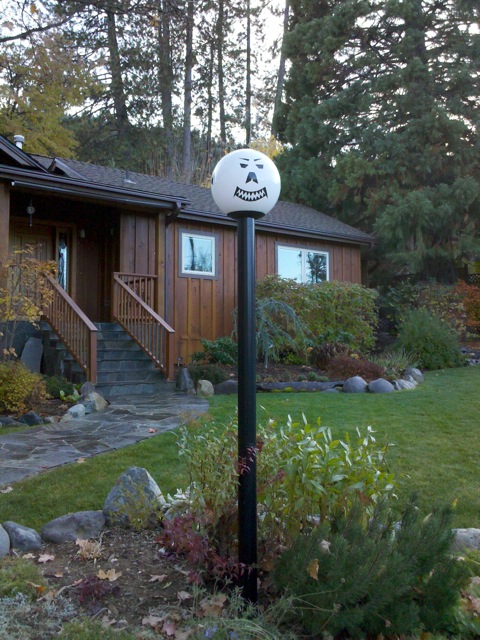
 Here is this year's O'lamp-post - created as usual with no plan, electrical tape, scissors, and an orange


.jpg)


 Posts
Posts